
A N A L Y S I S
The Coordination Gap
Human-AI Coordination as a Competitive Advantage
Published for Strategic.Global Magazine and
Strategic Communications Forum

An Emerging Constraint
Traditional organizational structures were never designed for accelerated flows of intelligence across systems, interfaces, and agents. Yet this is increasingly the operational condition of modern institutions.
Intelligence now moves through workflows, orchestration layers, machine-to-machine exchanges, and human decision processes with a speed and fluidity that many organizations struggle to coordinate.
This arrives at a moment when access to advanced AI capability is rapidly widening. Frontier models, orchestration frameworks, and intelligent agents are entering environments at an extraordinary pace. Yet organizational outcomes remain uneven. Some institutions absorb these systems into operational flow. Others accumulate intelligence faster than they can coordinate it.
The difference is less technical than organizational. Increasingly, it is expressed through communication: how priorities are interpreted, how direction is maintained, and how coordination persists across human and machine systems.
Microsoft’s Work Trend Index points to a familiar pattern: AI capability is accelerating faster than institutional adaptation. The result is not simply slower transformation, but growing misalignment between how intelligence is produced and how decisions are made. Trust calibration, role clarity, and coordination maturity increasingly sit at the center of transformation efforts, extending beyond earlier concerns with technical capability, adoption, and process redesign.
In a multi-agent architecture, communication shifts from the distribution of information toward the coordination of intent. Institutional confidence, interpretive alignment, and the ability to coordinate participation across human and machine systems emerge as increasingly important sources of advantage.
The constraint increasingly resides in communication and organizational design.
Understanding that shift requires a broader view of the changing relationship between humans and intelligent systems.
Datascape: The Coordination Gap
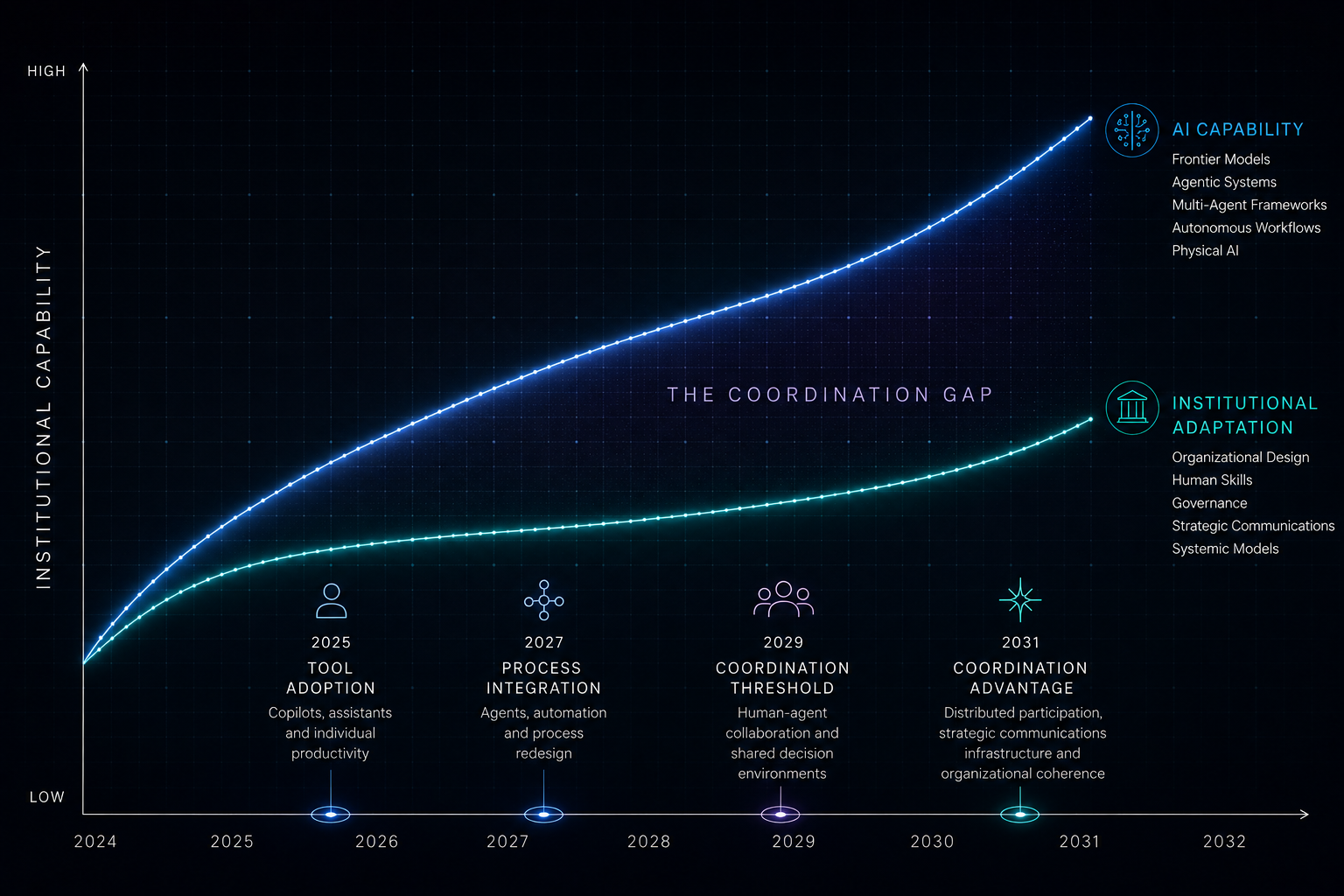
The datascape illustrates a widening gap between AI capability and institutional adaptation.
As intelligence becomes increasingly accessible through models, agents, and autonomous systems, organizational performance depends increasingly on the ability to coordinate people, systems, and agents around shared objectives.
Distributed Participation
The relational dynamics between humans and machines are also changing. Earlier generations of enterprise systems operated largely as instruments: software executed instructions, automated sequences, and extended computational reach. Agentic systems introduce a different operational presence where automation executes, assistants interpret, and agents coordinate.
Systems retain memory across interactions, infer priorities, initiate actions, and participate in machine-to-machine exchanges beyond direct human observation. A scheduling layer becomes a cross-process negotiator. A knowledge interface orchestrates information across teams. Decision support systems shape the tempo and direction of institutional activity.
Across infrastructure, logistics, service environments, and intelligent production systems, similar conditions are evident. Sensors, edge systems, predictive models, and multi-agent frameworks produce environments capable of registering conditions and initiating adaptive responses.
Communication follows a similar trajectory, with information moving through adaptive exchanges between people, agents, interfaces, memory systems, and processes operating simultaneously across environments.
This represents a reshaping of how organizations communicate, coordinate, and sustain institutional clarity. Decision cycles compress. Delegation expands into new layers of machine participation. Oversight shifts from discrete supervision toward continuous interpretation across adaptive environments whose logic may only be partially visible at any given moment.
The deeper challenge concerns how participation, direction, and coordination persist once intelligence diffuses across operational environments and at machine speed.

Coordination Thresholds
Highly adaptive technical systems, particularly in high-security contexts, have historically introduced moments where coordination, rather than capability, emerged as the limiting condition. In accelerated environments, the central problem often shifts from generating intelligence toward maintaining coherence across multiple interacting systems.
Multi-agent AI introduces similar pressures into organizational life.
This condition becomes especially visible when systems move beyond responding to requests and begin operating on behalf of individuals and teams. Coordination frameworks increasingly determine how priorities are interpreted, how trade-offs are negotiated, and how meaning propagates across organizations.
Objectives, interpretations and responses now circulate across networks of human and machine actors. Alongside its role in distributing information, strategic communication increasingly contributes to the maintenance of coherence across distributed forms of intelligence.
This creates a new coordination threshold. As intelligence proliferates across systems that continuously interpret, communicate, and act, coherence becomes increasingly difficult to sustain.
Organizational Coherence
Organizations rely on more than execution. They rely on the continued willingness of people to contribute judgment, context, creativity, and commitment over time. Intelligent systems increasingly shape the environments through which those dynamics are mediated.
Every institution depends upon collective sense-making. Objectives, priorities, and values acquire operational meaning through communication. As intelligent systems enter these environments, organizations face a new challenge: maintaining coherence across participants that process information differently, operate at different speeds, and possess different forms of visibility into organizational activity.
This raises key questions around augmentation and substitution. Systems designed to remove friction may simultaneously erode the formative processes through which judgment, resilience, creativity, and institutional learning emerge. Efficiency alone does not necessarily strengthen organizational capability.
Researchers at the MIT Media Lab’s Advancing Humans with AI initiative have framed this distinction through the idea of AI as an orchestrator rather than an oracle. The emphasis shifts toward systems that support human agency, collaborative discovery, and meaningful participation, rather than environments optimized solely around automated output.
This distinction matters inside organizations.
As intelligent systems become persistent collaborators, the texture of interaction begins influencing organizational culture itself. Communication patterns, role clarity, operational confidence, and perceptions of agency increasingly shape how people adapt to machine participation within institutional environments.
Trust therefore moves beyond cultural aspiration and enters operational design.
Designing for Coordination
As frontier models become increasingly accessible, advantage accrues to institutions capable of aligning people, systems, and agents around shared objectives. Coordination maturity becomes a source of strategic leverage.
McKinsey’s recent work on AI “superagency” points toward a similar conclusion: the challenge increasingly lies in redesigning work, decision-making, and operating models around intelligent systems rather than deploying the systems themselves.
Some organizations will develop environments where multi-agent systems operate with high degrees of coherence. Learning loops tighten. Decision velocity accelerates. Adaptive response moves fluidly across teams, systems, and workflows. Collaborative intelligence compounds through coordination.
Others may accumulate intelligence without coherence.
Disconnected deployments, fragmented oversight, opaque workflows, and institutional mistrust create environments where machine capability expands faster than organizational alignment. Under those conditions, complexity itself begins absorbing operational advantage.
The divergence may be substantial, as coordination maturity becomes strategic infrastructure.
Historically, internal and external communications focused on the distribution of information. In intelligent environments, its role expands toward the coordination of intent across distributed forms of participation. The challenge shifts from informing institutions to helping them remain coherent.
Strategic communication increasingly functions as an institutional infrastructure within intelligent environments. Institutions depend upon shared interpretation across distributed forms of intelligence operating at different speeds, through different interfaces, and across different layers of visibility.
Intelligence may be increasingly accessible. Coordination is where coherence emerges. Coherence is where advantage accumulates.
© 10 Sensor LLC, 2026 USA, International
NOTES: Period: 2025-2026 | Language: English | Conflict of Interest: None | Media & AI Usage: c/o 10sensor
References: The Coordination Gap, originally published by Strategic.Global (2026)| Microsoft, Work Trend Index 2026 | McKinsey & Company, The Agentic Organization (2025) | McKinsey & Company, Superagency in the Workplace (2025) | MIT Media Lab, Advancing Humans with AI Initiative (2025–2026) |
10sensor Applied Futures, Analysis Series (2025–2026