
A N A L Y S I S
The Cognitive Path
Designing for intelligent robotics
Building on previous policy research and keynotes
originally published for IBM Research Institute

Envisioning a new co-operation
Robotic technologies have evolved beyond automated task execution toward broader AI-enabled capabilities. Intelligent systems are steadily reshaping many aspects of knowledge work, changing how individuals and institutions view operations, coordination and decision-making.
For institutions and enterprises alike, fundamental questions emerge:
- How will intelligent robotics affect our operating model in the next five years?
- What becomes achievable through intelligent systems?
- What is the future of society through new forms of inter-agent co-operation?
Few, however, are making a great deal of progress beyond narrow demonstrations of capability and are now looking more seriously at broader operational and strategic transformation.As they look toward this horizon, appropriate, ethical strategy and governance models for automated decisions are beign sought, while laying the foundation for coordination across human and intelligent systems.
Questions for design
- Which cognitive functions should be automated, augmented or orchestrated differently?
- How will autonomous systems be governed, managed and supervised?
- How should governance frameworks encourage innovation while maintaining strategic control?
- How will value and differentiation be created with these new technologies?
- How will operational scale and coordination be ensured across interconnected systems?
- How will knowledge work be transformed?
- How will autonomous systems exchange information, and how will compliance, security and privacy be maintained?
- How will change implications be managed and new skills developed, particularly around orchestration, governance and analytical oversight?
- How will intelligent automation align with objectives for innovation, structural change and growth?

IBM Research Center, NY
Scenario planning
While the benefits of intelligent robotics extend well beyond cost reduction to encompass greater coordination and sophistication in design, few organizations understand the upfront and ongoing investment drivers.
To mature intelligent automation capabilities and delivery models, the enterprise should gain a thorough understanding of drivers, including orchestration and oversight, technology environments, skills development, analysis and controls. From this standpoint, intelligent robotics can be applied consistently and aligned with broader operational and strategic objectives.
As operational capacity and human potential are redistributed, post-automation strategic levers will need to be evaluated and the requirements for new skill sets assessed. High-value skills in orchestration, design, data curation and advanced analytics will be focus areas as new operational and societal opportunities emerge.
Market forces for labor and intelligent automation are evolving quickly and institutions should begin modelling scenarios and futures.
Orchestrating cognition
In defining an intelligent automation strategy and governance, a full spectrum of capabilities is required to execute and coordinate cognitive automation across end-to-end systems.
Process methodologies help identify critical steps to ensure inefficiency is not automated and operational agility is enhanced, with consistent approaches to redesigning operations through robotics, autonomics and distributed decision systems.
While autonomics represents the self-managing aspects of automation, intelligent robotics go further, incorporating artificial intelligence and learning disciplines, such as perception, attention, anticipation, planning, memory, learning and reasoning.
In laying the foundation for a path toward cognitive automation, a variety of capabilities should be developed within intelligent robotic frameworks:
- Intelligent applications
- Decision interfaces
- Process intelligence
- Autonomous orchestration
- Expert reasoning systems
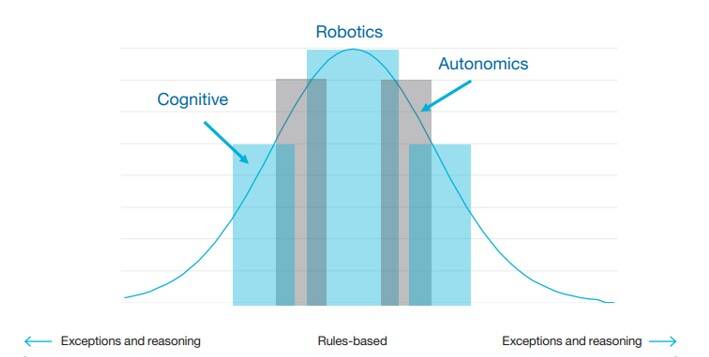
Image: IBM Research Institute, 2017
Aligning autonomy
Pilot projects often leave a gap between localized success and system-wide integration. Disconnected automation environments do not account for the complexities of change and technology integration at scale. Furthermore, the capabilities required for discrete automation environments, represent only a portion of the capabilities required for co-operation with intelligent systems at scale.
4 dimensions can be mapped on a maturity continuum to align autonomy in development practices and drive innovation:
- Identified opportunities
- Benefits sequencing
- Innovation ownership
- Strategic control
There are a vast array of processes and activities that can be automated.
Human and intelligent systems alike should have the freedom to adapt, automate and innovate, and yet, be strategically aligned for scale and technology governance. Maturing through narrow implementations, toward fully embedded inter-agent systems, and a shared path toward expanded cognitive capability.
FORESIGHT MEDIA: c/o CAN Robotics (Digital Surgeon)
© 10 Sensor LLC, 2018-2019 USA, International
NOTES: Period: 2016-2019 | Language: English | Conflict of Interest: None | Media & AI Usage: c/o 10sensor
References: Expansion of research originally published by IBM Research Institute, 2017 | 'Cognitive Automation', Key Note Talk, Watson Research Center, 2017 and IBM Think, 2018 |'Strategic Hub for Innovation', Working Group, Securities & Exchange Commission, 2016
Back to Analysis