
A N A L Y S I S
Get Physical
Embodied intelligence
in the built world
Foresight instrument developed for regional societal impact planning, and building on foresight briefing for global mobility and public health infrastructure.

Inevitably, the built environment is becoming increasingly interactive and intelligent, reshaping a historical relationship between humans, computation, and physical systems.
Distributed intelligence has roots in sensor networks and ecological design thinking, and yet, Physical AI extends this trajectory, introducing an agentic layer embedded within the fabric of everyday environments. From wearables and domestic appliances to mobility systems, architecture, and urban infrastructure, the medium of intelligence becomes spatially distributed.
In this context, robotics and AI are no longer confined to discrete instances, but are more a wider field of adaptive environments capable of perceiving conditions, interpreting signals, and initiating responses with increasing autonomy.
This foresight instrument is developed to support societal impact planning for embodied intelligence, offering structured interpretations across multiple domains of the built environment.
Datascape: Physical-AI Adoption
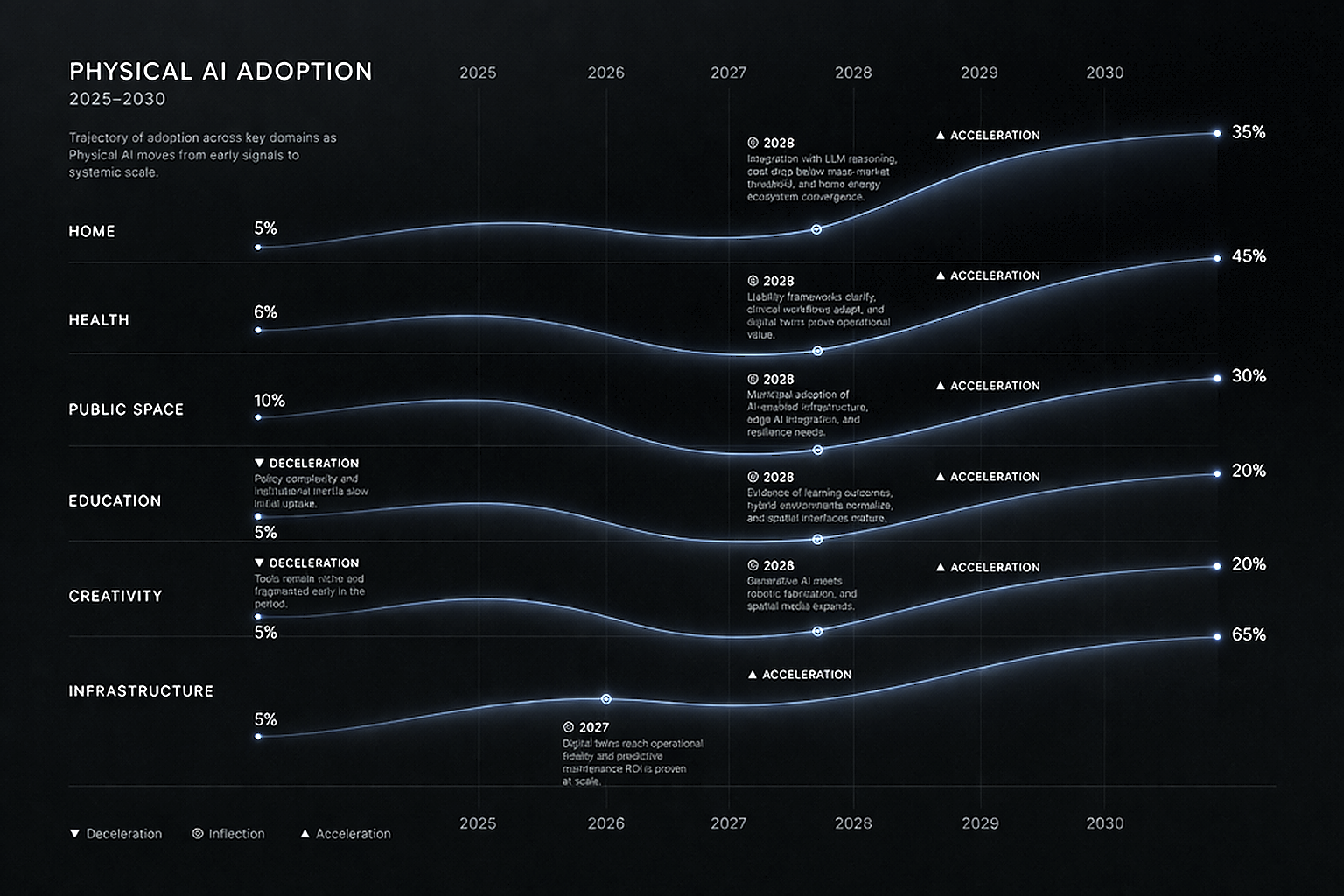
Overview: 2025-2030
The datascape depicts the material presence of AI in physical environments, moving from computational augmentation toward embedded agency in the built world.
The curves represent composite signals derived from converging thresholds for technological, economic, and institutional drivers.
Physical-AI intensity increases with the alignment of three conditions:
- Cost compression in sensing, actuation, and computation
- Orchestration maturity through agentic frameworks
- Acceptance of machine autonomy in operational contexts
Enabling infrastructure will become a substrate for other domains, explaining steeper trajectories.
Across societal domains, the curves show staggered acceleration rather than synchronized growth. This suggests physical AI will not diffuse evenly but will cluster where operational complexity and the cost of human intervention is high, and where digital representation of the environment already exists.

Societal Interpretations
HOME
Initial adoption reflects narrow-task automation. Early deployment focuses on discrete convenience functions such as navigation, monitoring, and environmental adjustment.
Acceleration
- Domestic robotics platforms converge with LLM-based reasoning layers
- Component costs fall below psychological price thresholds
- Integration with home energy and security infrastructure becomes standardized
Foresight
The home becomes an adaptive micro-environment rather than a passive container of devices.
HEALTH
Physical-AI intensity increases through surgical robotics, automated diagnostics, continuous monitoring, and logistics automation inside care systems.
Acceleration
- Liability frameworks stabilize around AI-assisted clinical decision support
- Digital twin modelling of organs and treatment pathways becomes operationally useful
- Hospital workflow optimization demonstrates measurable productivity gains
Foresight
Healthcare shifts toward continuously adaptive care environments rather than episodic intervention models.
PUBLIC SPACE
Public environments adopt sensing and robotic capability through transport, safety, logistics, and urban maintenance.
Acceleration
- Municipal procurement frameworks adapting to AI-enabled infrastructure
- Integration of edge AI with smart city platforms
- Increased need for resilience monitoring in climate-exposed environments
Foresight
Public infrastructure becomes responsive rather than static.
EDUCATION
Education adoption curves are initially constrained by institutional inertia and policy complexity.
Acceleration
- AI-mediated tutoring demonstrates consistent, measurable outcomes
- Hybrid physical-digital learning environments become normalized
- Spatial computing interfaces reduce friction between digital and physical learning modes
Foresight
Learning environments transition from curriculum delivery to adaptive cognitive scaffolding.
CREATIVITY
Creative environments incorporate robotic fabrication, generative physical interfaces, and hybrid studio environments.
Acceleration
- Convergence of generative AI with robotic fabrication tools
- Expansion of immersive spatial media
- Reduction in the cost of programmable materials and responsive environments
Foresight
Creative production becomes partially co-evolutionary between human and machine systems.
INFRASTRUCTURE
Infrastructure exhibits the strongest acceleration gradient due to clear economic incentives and large-scale operational leverage.
Acceleration
- Digital twins become continuously synchronized with real assets
- Predictive maintenance demonstrates consistent ROI
- Autonomous inspection and repair systems reduce downtime risk
Foresight
Infrastructure becomes anticipatory rather than reactive.

Acceleration & Friction
1. Unit economics of embodied intelligence
Declining costs across sensors, edge compute, robotic components, and energy efficiency reduce deployment barriers. The shift is non-linear, where hardware cost curves remain flat until the supply chain scale triggers rapid compression.
2. Reliability thresholds
Adoption accelerates when systems reach predictable reliability under real-world variance. Simulation environments and digital twins reduce risk before physical deployment.
3. Institutional trust gradients
Physical AI adoption depends on tolerance for machine autonomy in safety-critical contexts. Domains with clearer regulatory pathways or measurable ROI accelerate faster.
4. Agent orchestration maturity
Multi-agent coordination frameworks allow physical systems to operate as networks rather than isolated machines. Coordination reduces the marginal cost of scaling deployments.
5. Infrastructure coupling effects
Physical-AI adoption correlates strongly with existing digital infrastructure maturity. Domains with prior automation layers provide attachment points for agentic capability.

Synthesis
Physical-AI does not emerge as a single technological wave but as a layered transition across environments where sensing, reasoning, and actuation converge.
The datascape indicates that embodiment is governed less by technical possibility alone, and more by the interaction between economic thresholds, institutional readiness, and the maturity of coordination frameworks.
Domains accelerate at different moments because they operate under different constraints. Healthcare depends on trust calibration, and liability clarity. Domestic environments depend on cost compression and usability thresholds. Infrastructure evolves more rapidly because operational efficiency gains are measurable and system-level coordination already exists. These differences produce staggered inflection points rather than synchronized adoption.
Taken together, the trajectories suggest that the built world becomes progressively computational in its behaviour. Environments begin to register conditions, interpret signals, and initiate responses without continuous human direction. Agency becomes distributed across systems that were previously passive.
Physical-AI therefore, represents a structural shift in how intelligence is expressed in society. Software no longer remains confined to screens but becomes embedded within logistics networks, medical systems, domestic environments, and public infrastructure. The boundary between digital capability and material process becomes less distinct.
The significance of this transition lies not only in automation, but in the emergence of environments capable of adaptive response. The built world evolves from static architecture toward dynamic infrastructure that participates in decision processes.
Foresight Instruments provide a method for observing where these shifts are likely to concentrate and where experimentation may translate into operational dependence. Monitoring acceleration zones becomes a practical mechanism for anticipating where embodied intelligence begins to influence economic structures, institutional design, and everyday experience.
Physical-AI is less a discrete category of technology than an evolving condition of the societal environment.
© 10 Sensor LLC, 2026 USA, International
NOTES: Period: 2024-2025 | Language: English | Conflict of Interest: None | Media & AI Usage: c/o 10sensor
References: Stanford HAI AI Index Report (2025) / International Federation of Robotics Outlook (2024–2025) / OECD AI Policy Observatory (2024–2025) / NVIDIA GTC Physical AI framing (2024–2026) / Microsoft Research AutoGen papers (2024–2025) / NIST Digital Twin research (2023–2025) / European Commission Industry 5.0 framework (2021) / McKinsey Global Institute AI productivity research (2023)