
A N A L Y S I S
More Reality
Visions of extended and
distributed presence
V.1
Building on policy research developed for The Institute for the Future, Skills Module and foresight briefing for Intelligent Connectivity Infrastructure, US and APAC.

Somewhere else
Even before the global pandemic of the early 2020s, it had become clear that we had begun to leave our cities and much of our physical surroundings. The exodus initiated, we had gone ‘somewhere else’. Proximity gave way to attention, as people became consumed by smart devices, and the ambient telepresence of activities from across the planet. Ideas, voices and faces, always with you, more ‘present’ than a physical engagement. In the new world that is steadily redefining geographic space, 2020 saw a pivotal shift for civilization. Alerting us to how this century will be characterized by a new wave of telepresence, integrated with synthetic intelligence and notions of extended reality.
We are entering a new understanding of how information creates our environment and recasting ourselves as informational entities that may be transported through a wider context of distance, time and space. In a period where we are faced with remote activity and social distance, extended reality, or ‘XR’, can be seen as a unifying medium, with a fantastic array of opportunities to visit, work and live in previously unreachable or inhospitable environments. VR travel, education and healthcare, planetary exploration and interaction with inter-agent societies. All such endeavors, once liberated from human constraints, provide profound opportunities for advancement.
Drivers of change
While societal governance of the age remains challenged, technology enterprises are meeting the opportunities with stunning creativity. Platforms such as Spatial.io, provide VR and avatar collaboration spaces, pointing to the possibilities of integrating everyday life with a three-dimensional internet. Telepresence robots, initially simplistic in form, are rapidly expanding in sophistication and implementation. ANA in Japan has been executing a multi-year global avatar competition, to create systems that will “transport senses, actions and presence to a remote location in real time”. Powered by “Robot-as-a-Service” models, the scope is aligned with the slogan, “anywhere is possible”.
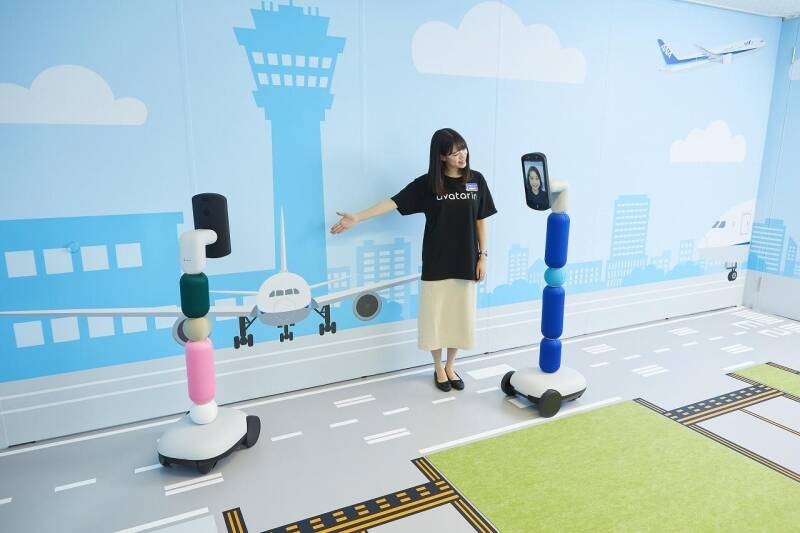
ANA Avatar, Japan. Remote presence and avatar interaction environments.
Consumer VR platforms have extended immersive tourism and simulation experiences to wider audiences, with an expanding range of natural and computer-generated experiences. Major technology firms increasingly viewed immersive environments as a future extension of everyday computing. Apple are preparing to launch augmented reality interfaces over the next 3 years, and Microsoft’s HoloLens is already deployed within industrial production and analytics. Scientists at the University of Cambridge have presented vLUME VR, where researchers can ‘walk through’ cells and neurons, to understand structures and develop treatments. Experimental environments are increasingly exploring haptic and emotional feedback, with embodiment as the primary interface and a new scope of affordance.
Samsung have published a bold vision for 6th Generation telecommunications, including holographic telepresence and digital replicas for physical objects. At the 6G Summit in Helsinki, speakers from Ericsson and Nokia elaborated on the “unification of physical, digital and biological worlds”. These advancements imply deeper redesigns across radio systems, sensing environments, networks and data architecture. While many institutions project mainstream adoption across the coming decade, the architectural challenges are immense, requiring far reaching perspective and investment. In the current 5G realm, China’s Huawei have proved innovative and controversial, yet their combined research with Oxford Economics in the UK, has helped define the concept of “Digital Spillover”, measuring a wider and more accurate extent of digital economic impact.
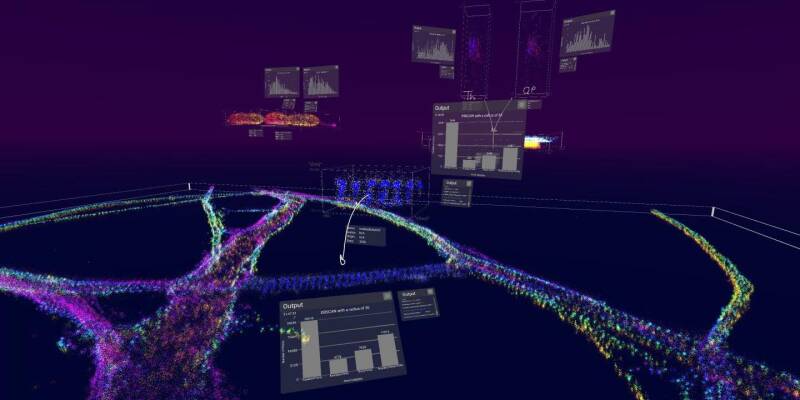
Cambridge vLUME VR. Immersive scientific visualization environments.
New models
These are just some of the breakthrough solutions racing to aid our creative, ecological and digital lives. XR and AI environments will increasingly operate continuously across personal, industrial and institutional contexts, for us and with us, reshaping interaction between environments, people and emerging forms of intelligence. These mediums are psychologically powerful , with the shift to continuous, frictionless change, versus the historical speed of human change, requiring new models for interaction. Avatar agents may operate across environments inaccessible or inhospitable to human. They can attend events on our behalf, operating with each other across different domains, and with the emergence of XR analytics, we will collaborate in immersive 3D motion.
It is important that innovation strategists and architects step-up in the design and governance of new experience architectures and ecosystems. Historically, telepresence research has lacked coordinated effort, and while the internet brought a handful of trillion dollar information technology enterprises, the advent of XR, AI and 6G will see many more organizations operating at this scale. Deeper international cooperation will be vital to harness the potential and collaboratively interpret ideas generated by non-human intelligence, as well as fostering XR interaction that transcends platform-dependency. Today, a few coordinated and interdisciplinary programs are emerging.
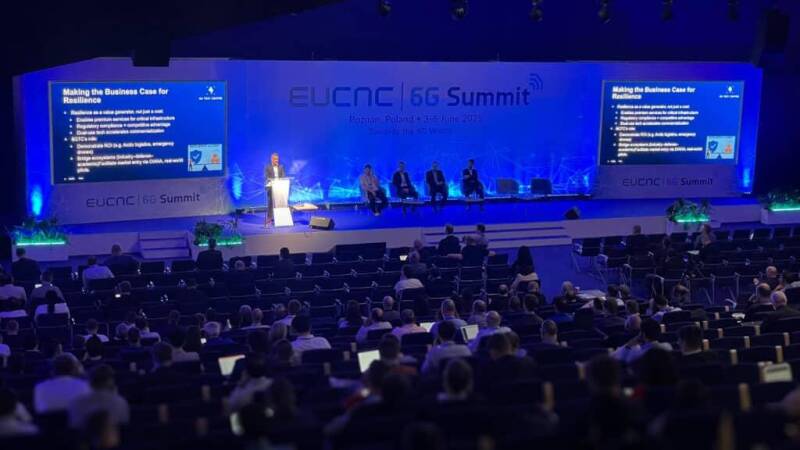
6G Summit, Helsinki. Telecommunications and infrastructure discussions surrounding immersive and distributed environments.
Architecting the future
In the first example, and responding to investment by other major economies, the Government of Japan has established a unit for Future Innovation Research. A consortium of science, technology and healthcare institutions, programs are organized around radical goals, targeting global environmental recovery, frontier economics and techno-social transformation. Forecasting to 2050, topics include reducing the limitations of body, brain, space, and time, ultra-early disease protection to at least a 100 year life span, coexistence with AI robots and preparations for a post-anthropocentric earth. Young audiences have been engaged in the solution assessment processes, to bring fresh perspective and directly involve generations that may inherit the results.
A second example is the development of China’s VR ecosystem. The Ministry of Industry and Information Technology has defined detailed guidelines and long-range planning, spanning ideology, development, key technologies, supply-chain, security and promotion. Immersive infrastructure is regarded as central to long-range growth and technological coordination and policies ensure investment by financial institutions, business model adoption, integration within educational systems and support from local governments. China and the US combined account for well over half of all global VR investment and it will be beneficial to define international standards and collaboration. Open source, cross-platform development will support deeper engagement with international ecosystems, risk mitigation and enhanced experiences.
The third example tackles the core enabler of XR and AI society, 6G. The Next G Alliance was established in 2020 by the Alliance for Telecommunications Industry Solutions, based in Washington DC. It comprises of US big-techs, with major players from Canada, Japan and South Korea. The initiative will lay out a clear roadmap for government policy, funding and execution. The last 3 years has seen a renewed awareness in core ICT infrastructure and the vision for “6G and beyond” implies a deeper alignment of myriad technological concerns. These will ultimately span 3D intercoms in air, sea and land, cognitive radio for spectral efficiency, edge computing, brain-computer interfaces and synthetic intelligence systems.
The Government of Japan have invested $1BN USD in an R&D consortia focused on radical future solutions

Image: Visions & Examples: Moonshot R&D Program, 2018
Available reality
These three initiatives will not be the last, emphasizing the scope of revolutionary challenge for civilization, society and the new enterprise. Interdisciplinary skills, human-AI cooperation and technocratic expertise will be required, to integrate these capabilities within everyday contexts and values. Innovation strategists and architects will increasingly work alongside experts in gaming, psychology and human-rights. Beyond pure technical aspects, they will need to accommodate transparency in the manufacture and distribution of communications, influence and experience. Expansive, whole-system data and resilience will intensify with the advent of embodied interaction, virtual lifestyles and inter-agent societies.
Today, our senses experience but a microcosm of available reality. There are sights we can’t yet see, sounds we can’t yet hear, materials we can’t yet touch, data and communications we can’t yet process. The transformation of technological architecture and emergence of new telepresence lifestyles will enable deeper experiences, interactions and distributed capabilities, as we extend ourselves into more reality.
FORESIGHT MEDIA
Visions & Examples: Moonshot R&D Program, 2018 | www.openaccessgovernment.org
© 10 Sensor LLC, 2020 USA, International
NOTES: Period: 2016-2020 | Language: English | Conflict of Interest: None | Media & AI Usage: c/o 10sensor
References: '6G Spectrum: Expanding the Frontier', Samsung, 2020 | Moonshot R&D Program, Government of Japan, 2018 | 'Digital Spillover', Huawei & Oxford Economics, 2017 | 'VR Ecosystem' Industry of Virtual Reality Alliance, 2016 | 6G and Beyond, NextG Alliance, 2020
Back to Analysis