
A N A L Y S I S
A Quiet Orchestra
The invisible hand of
ambient intelligence
Building on published keynotes on AI Convergence, US
Evolution 03-25-2026

Ambient Intelligence (AmI) is a world where technology seamlessly integrates with all our environments, invisible yet ever-present.
A concept in which smart devices, AI, and sensor networks work quietly in the background, adapting to human behaviors and needs without overt interaction.
Unlike traditional computing, where we actively engage with machines, Ambient Intelligence embeds technology into the fabric of our daily lives - homes, workplaces, cities, even our bodies.
In fact, AmI may bring some relief to the recent periods of information overload and digital coordination. During this time, and despite rapid technology investments, relative automation productivity has actually slowed, with digital systems requiring explicit interaction.
AmI represents an evolution in the scale of intelligence, and in how we experience the digital world. Moving from active to passive interaction. A calming background presence, freeing us to collaborate with superscale systems in location-independent activity.
In this world, your environment "knows" you. It learns, senses, and responds. Lights dim for sleep, climate adjusts as you move through rooms, data flows invisibly through your surroundings, influencing all aspects of public infrastructure.
This vision of technology is responsive, intuitive, and anticipatory - working in sync with human needs.
The future of Ambient Intelligence is one of quiet orchestration. A convergence of the physical and digital world. As it grows, AmI challenges us to think about the ethics of privacy, autonomy, and the nature of control. Yet, it also promises a future where technology enhances our lives in profound, unobtrusive ways - helping us live more comfortably, efficiently, and sustainably.
In Ambient Intelligence, technology dissolves into the fabric of existence. An unseen force that shapes the rhythm of human life, as essential and intangible as the atmosphere itself.
“They didn’t see it coming because it didn’t arrive with a roar. It arrived on tiptoe, like fog.” - The Martian Chronicles, R Bradbury
Datascape: Automation Intensity Constellation
Reflecting the degree to which execution, coordination, and decision processes are performed by intelligent systems. Signal datasets are combined across physical mechanization, control systems, electronic and digital workflows, machine learning, sensing, and adaptive feedback, projecting out toward continuous learning systems.
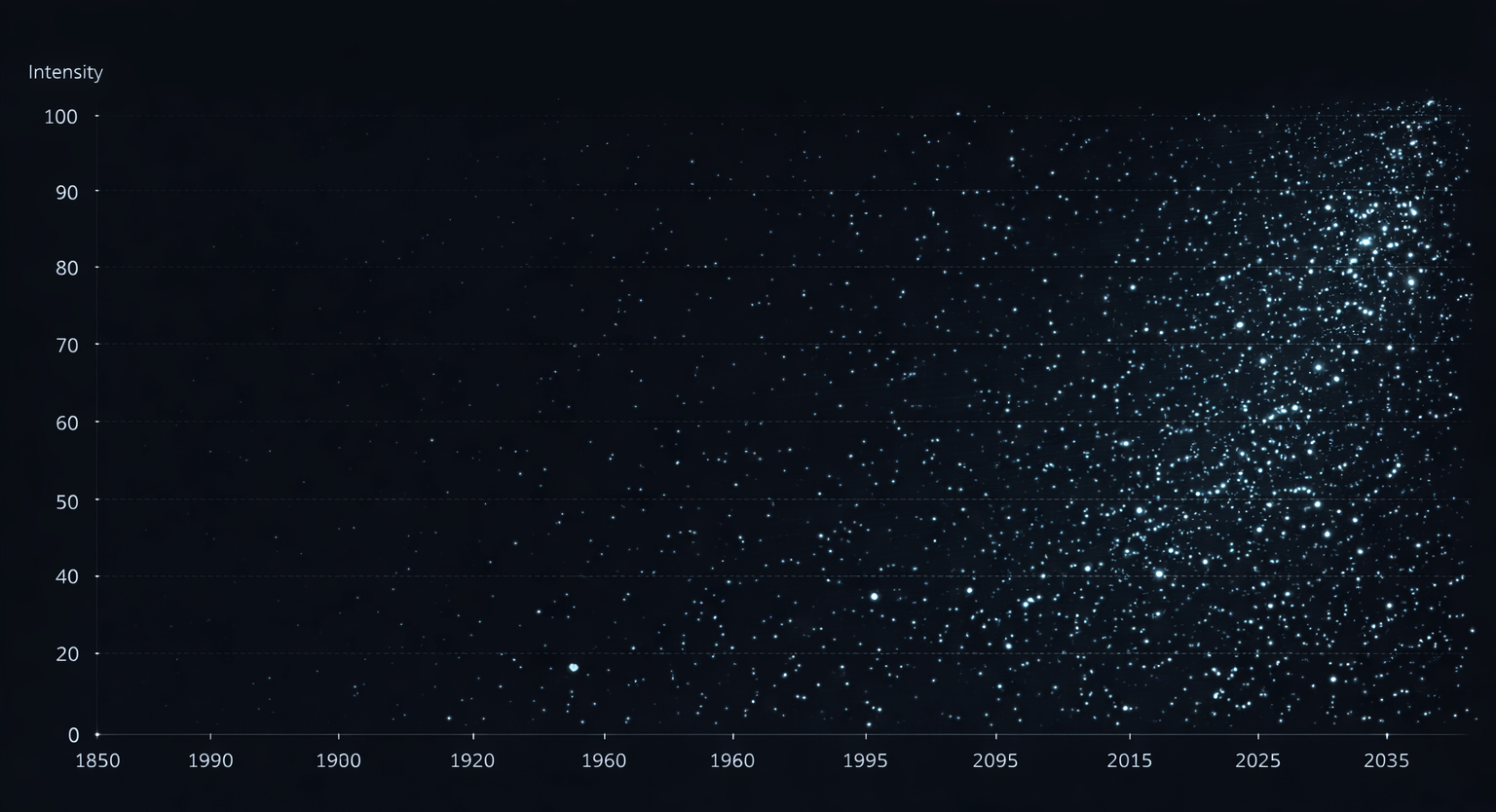
Automation has evolved in distinct waves:
- 1850-1920: Productivity increases with intelligence embedded in process
- 1930-1970: Intelligence moves from humans into control systems
- 1970-2005: Digital coordination and distribution of intelligence
- 2005-2025: AI systems introduced adaptive decision layers
- 2025-2035: Intelligence shifts toward environmental infrastructure
© 10 Sensor LLC, 2022-2025 USA, International
NOTES: Period 1991-2024 | Language: English | Conflict of Interest: None | Media & AI Usage: c/o 10sensor
References: Ubiquitous computing (Wieser, 1991) | Ambient intelligence research (Philips, European Commission IST Advisory Group, c. 1997-2005)
Back to Analysis