
A N A L Y S I S
Synergy with Robots
A choreography of
gesture

The boundaries between human and machine will become increasingly difficult to locate. Not because biological and computational systems are converging into sameness, but because intelligence itself is beginning to emerge through interaction, feedback, gesture, and shared environments of perception.
This shift is reshaping the pulse of human-machine collaboration itself. The machine no longer operates solely as an instrument of automation or distant analytical computation. The rise of physical AI, humanoid robotics, and adaptive systems introduces a more relational condition, one in which intelligence develops through interaction, feedback, and shared behavioural space.
Sougwen Chung’s Ecologies of Becoming explores the transition through a prolific creative and speculative practice situated somewhere between drawing, robotics, sculpture, sound, and computational performance. As artist, researcher, and engineer, Chung dissolves the boundaries between human intent and technological intervention, constructing environments where creative production emerges through reciprocity rather than control.
The practice is not about automation. Its central focus is entanglement, through a choreography of gestures between person and program, improvisation and computation. The machine is a participant.
More than Machine
Chung’s practice has centred on the D.O.U.G. series (Drawing Operations Unit Generations). These are robotic systems trained on her own gestures, movements, and drawing behaviours. The systems do not merely reproduce pre-programmed outputs. Through repeated interaction, they inherit behavioural tendencies, rhythms, and traces of motion that evolve over extended timescales.
This is a subtle yet important distinction. The robotic gesture appears less as mimicry than as behavioural echo, an emergent continuation of movement refracted through computational interpretation.
In this view, the machine moves beyond a traditional role of instrument. The interaction resembles a collaboration where human and machine operate together at the level of electrical signals, within a shared cognitive and perceptual environment.
These dynamics increasingly resonate with broader developments in physical AI collaboration and social robotics. As humanoid systems move into workplaces, homes, healthcare, and public environments, intelligence may become defined not only by capability or reasoning, but by the capacity to navigate relational space, gesture, timing, and co-presence with humans themselves.
In this sense, Chung’s work functions less as speculative abstraction and more as an early perceptual framework for understanding collaborative intelligence in embodied form.
Gesture as Interface
Much of modern computing evolved through abstraction. Interfaces became increasingly detached from the body, mediated through screens, symbolic inputs, and invisible infrastructures. Yet physical AI is reversing this trajectory. Robotics, spatial sensing, wearables, and adaptive environments are returning computation to movement, posture, proximity, and physical interaction.
Ecologies of Becoming exists in this space. Movement as machine memory. Behavioural data, repetition and adaptation.
Underlying this exchange is a deeper convergence between human and machine cognition at the level of signal. Biological nervous systems and computational systems both operate through pulses, electrical activity, transmission, feedback, and response. Chung’s work exposes this shared substrate. The choreography unfolds not only visually, but as an interaction between living and synthetic forms of signal processing.
This gives the work an unusual philosophical depth. Technology appears increasingly as a new membrane for existence, an extension through which perception, cognition, and expression flow outward into computational environments, as cognitive extension.
Cybernetic Presence
What makes the work compelling is that it resists reducing the human body to pure optimization. Imperfection remains visible throughout the interaction. Drift, hesitation, uncertainty, and variation persist within the robotic systems, rather than being removed in pursuit of mechanical precision.
This creates an ethereal form of machine presence, neither fully autonomous nor entirely subordinate. Rather, the systems occupy an ambiguous space between tool, collaborator, mirror and participant.
The interaction is less an industrial workflow than an improvisational performance, a recursive negotiation between organic creativity and algorithmic process.
In many ways, the work recalls contemporary cybernetic systems, environments shaped through continuous loops of sensing, adaptation, and mutual influence. But the introduction of ambiguity, intimacy, and embodiment into the loop blurs the category itself into a shared ecology of cognition.
Ecologies of Coexistence
An ecology is not a fixed structure but a network of relationships, adaptive, interdependent, and continuously evolving. The act of “becoming” similarly rejects permanence in favour of ongoing transformation.
Together, these ideas reposition AI away from dominant narratives of efficiency and control, toward systems of mutual influence between humans, machines, environments, and signals.
This perspective feels increasingly relevant as AI systems become embedded within day-to-day life. The manifestations of physical AI will blur distinctions between object, interface, assistant, and social presence.
Collaborative Intelligence
For much of technological history, machines amplified labour while software amplified information processing. But social robotics and embodied AI introduce another condition entirely: systems capable of participating within shared environments of movement, attention, and behaviour. This changes the cultural meaning of intelligence.
Ecologies of Becoming ultimately suggests that the future of AI may not arrive through separation from humanity, but through increasingly entangled forms of co-evolution. Not artificial systems replacing human creative production, but hybrid ecologies where cognition, perception, and expression move fluidly across biological and computational forms.
As physical AI systems continue to evolve, the challenge will not be only technical capability, but cultural adaptation: how humans learn new modes of interaction, how perception extends into responsive systems, and how cognition itself becomes distributed across human and machine environments.
In Chung’s work, this future does not emerge through spectacle or domination, but through gesture, reciprocity, and the choreography of becoming-with machines.
It is not about robotics or digital art.
Datascape: Physical-AI Adoption in Society
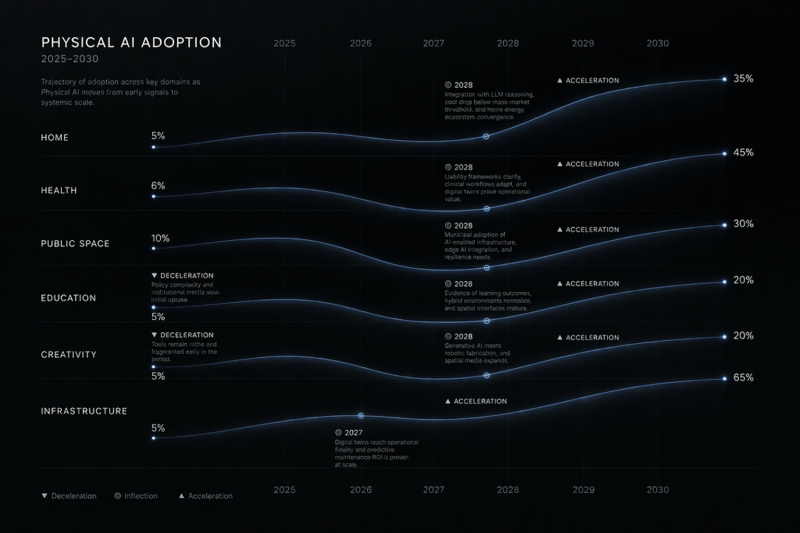
The datascape shows an increasing material presence of AI in physical environments, moving from computational augmentation toward embedded agency in the built world. The curves represent composite signals derived from converging technological, economic, and institutional drivers, where Physical-AI is less a discrete category of technology than an evolving condition of the societal environment.
FORESIGHT MEDIA: c/o Scilicet Studio
© 10 Sensor LLC, 2023-2025 USA, International
Back to Analysis